
You film a video for a brand. The lighting is good, the product looks great, and you explain every feature. Then the results come in, and almost nobody bought. The problem usually is not the product or the camera. It is the first 3 seconds.
On Trybe, a performance based UGC platform, your pay can depend on how well your videos sell as ads. That makes the hook the most valuable skill you can learn. This guide shows you how to write hooks for UGC, with real examples you can copy and adapt today.
What Is a Hook, and Why Does It Matter So Much?
A hook is the opening moment of your video that makes someone stop scrolling. UGC stands for user generated content, meaning videos made by everyday people instead of polished ad studios. Brands love UGC because it feels like a friend’s recommendation, not a commercial.
Here is how Trybe connects the hook to your paycheck:
- You join a brand campaign inside the app and often receive a free product sample.
- You film and submit a video that follows the brand’s brief.
- The brand runs it as a paid ad, often through whitelisting, which means the ad runs under your name or profile using the brand’s ad budget.
- Performance campaigns pay commission based on how that ad performs, so more sales can mean more money for you.
If nobody stops scrolling, nobody watches. If nobody watches, nobody buys. That is why the hook is the main skill that determines pay on a performance platform.
The 3 Layers of a Strong Hook
Beginners often think a hook is just the first sentence. The best hooks stack three layers at once, so they work even with the sound off.
- Visual hook. What the viewer sees first: the product in your hand, a messy before shot, or an unexpected movement.
- Spoken hook. Your first line, said with real energy and no slow warm up like “Hey guys, so today.”
- Text overlay hook. Words on screen that repeat or sharpen the message, because many people scroll on mute.
When all three point at the same idea, viewers understand the video’s promise in under 3 seconds. That clarity is what earns the next 10 seconds.
Hook Examples by Angle
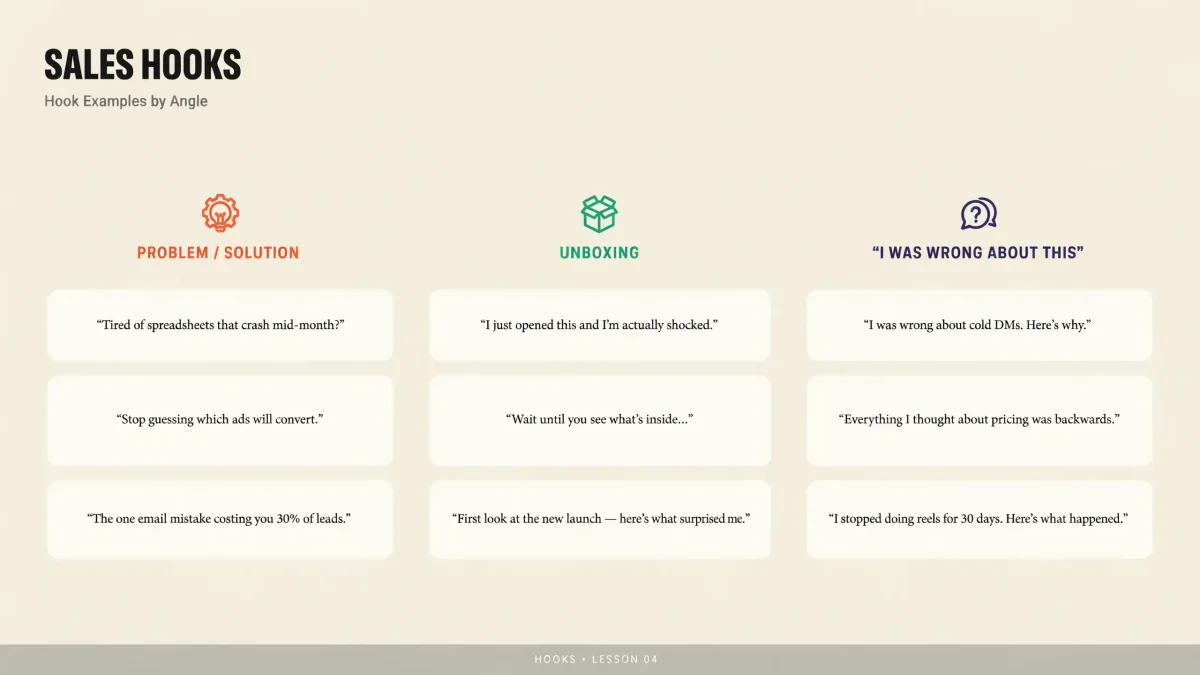
An angle is the story you choose to tell about a product. The same item can be sold with very different angles. Here are three proven ones, with examples you can adapt.
1. Problem/Solution Hooks
This angle opens with a frustration your viewer already feels, then shows the product as the fix. It works because people stop for their own problems, not for products.
- “If your dog sheds on everything you own, watch this.”
- “I was spending 20 minutes on my hair every morning until I found this.”
- “Stop buying new water bottles. Your old one just needs this.”
Visual tip: show the problem first. Hold up the hairy couch cushion or the tangled cords before the product ever appears.
2. Unboxing Hooks
Unboxing works because of curiosity. Viewers want to see what is inside and whether it lives up to the hype. The trick is to skip the slow tape cutting and open on the reveal or a reaction.
- “This came in the mail and I did not expect it to be this big.”
- “Everyone keeps asking about this, so let’s open it together.”
- “I paid nothing for this, and I’m still going to be honest about it.”
Visual tip: start mid action, with the box already half open and your hand pulling the product out.
3. “I Was Wrong About This” Hooks
This is the skeptic turned believer angle. Admitting doubt builds trust fast, because it sounds like a real person, not a sales pitch. Viewers who share your doubt stay to see what changed your mind.
- “I made fun of this for months. I owe it an apology.”
- “I thought this was a gimmick. I was wrong.”
- “I almost returned this. Here’s why I’m glad I didn’t.”
Important: only use this angle if it is true for you. Honest doubt converts. Fake doubt gets spotted, and it can break platform and advertising rules.
A Simple Formula for Writing Your Own Hooks
You do not need to be a natural writer. Use this fill in the blank formula: Who it’s for + the problem or surprise + a reason to keep watching.
Example: “Busy moms, if dinner takes you an hour, this cut it to 15 minutes.” Calling out the viewer makes the right people feel seen, which is exactly who the brand wants to reach.
Why Brands Want Multiple Hooks
Here is something many beginners miss. Brands running paid ads constantly test variations to find a winner. A single video with three different openings gives them three ads to test for the price of one.
- Film the body once. The demo and explanation stay the same.
- Record 3 to 5 hooks. Try one from each angle above.
- Label them clearly. Name files “Hook 1 Problem,” “Hook 2 Unboxing,” and so on.
Offering extra hooks (when the campaign allows it) gives your content more chances to become the ad that scales, and that is where performance pay grows.
Common Hook Mistakes to Avoid
- Slow intros. Saying hello or your name wastes your most valuable seconds.
- Leading with the logo. Viewers scroll past anything that looks like an ad.
- Vague promises. “This is amazing” says nothing. “This cleaned my grout in 2 minutes” says everything.
- Exaggerated claims. Never promise health results or outcomes the brand has not approved.
The Honest Downsides
- Earnings are not guaranteed. On performance campaigns, a great hook on a weak offer may still not sell.
- You don’t control the ad. The brand decides budget, targeting, and how long it runs.
- Results take testing. Your first several hooks may flop, and that is normal.
Beginner tip: keep a swipe file. Save every hook that stops you while scrolling, then study why it worked. It is the same first impression thinking behind YouTube thumbnails that get clicks.
How to Get Started This Week
- Study 20 ads in your niche. Write down only the first line of each.
- Practice with products you own. Film three hooks for something in your kitchen.
- Read every brief carefully. Brands often list required talking points and banned claims.
- Apply to a few campaigns. Start with products you would genuinely use.
- Track what wins. Note which angles perform best and do more of those.
If you also post product videos elsewhere, these same skills transfer directly to the Amazon Influencer program and to social media management work for small businesses.
A Quick Reality Check on Money
Treat your first month as practice, not payday. Track every payout and every product you receive, because free samples may count as taxable income. Setting realistic expectations is part of how side hustles actually work.
Three Seconds to Win the Sale
On a platform that pays for results, your hook is your paycheck. You do not need fancy gear or a big following. You need to win the first 3 seconds, again and again.
Start with the three angles, film multiple openings, and keep testing. Every hook you write makes the next one better, and that skill compounds into real income over time.