
You have probably seen the videos. Someone holds up a face serum or a water bottle, talks to the camera for 30 seconds, and gets paid for it. Then you hit a confusing question: should you take a guaranteed flat fee per video, or bet on performance pay that could pay far more (or nothing at all)?
This post puts flat fee vs. performance pay for UGC side by side using real numbers from Billo, JoinBrands, and Trybe. You will see what each pays a beginner, run three realistic scenarios, and find which model fits your risk tolerance.
What Is UGC, and How Do the Two Pay Models Work?
UGC stands for user generated content. It is short, casual video made by everyday people that brands use in ads and on product pages. You usually do not need a big following, because the brand runs the video, not you.
There are two main ways UGC creators get paid:
- Flat fee. You get a set amount for each approved video, no matter how it performs afterward.
- Performance pay. You earn based on results, usually a commission (a cut) on each order or a percentage of the sales your video drives.
It is the classic trade between certainty and upside, which is how side hustles actually work in general.
The Flat Fee Platforms: Billo and JoinBrands
Billo
On Billo, you film videos from a brand’s brief in the Billo Creator app. Your payout depends on your tier (Regular or Premium) and the video length. Billo says its fee is charged to the brand, so the amount shown on a job is what you receive.
Entry level jobs commonly pay around $30 per video, and rates rise once you reach Premium. Brands pay Billo from $99 per video, so the platform keeps a big share for finding the work.
JoinBrands
JoinBrands works like a job board: brands list paid campaigns, and you apply. Video jobs start around $60, posting on your own TikTok pays more, and photos start around $15. You often keep the product too.
The catch is the platform fee, a cut the platform takes from your earnings. It is 20% on the free plan and 15% with Creator Pro, which costs $49.95 per month. So a $60 job puts about $48 in your pocket on the free plan.
The Performance Platform: Trybe
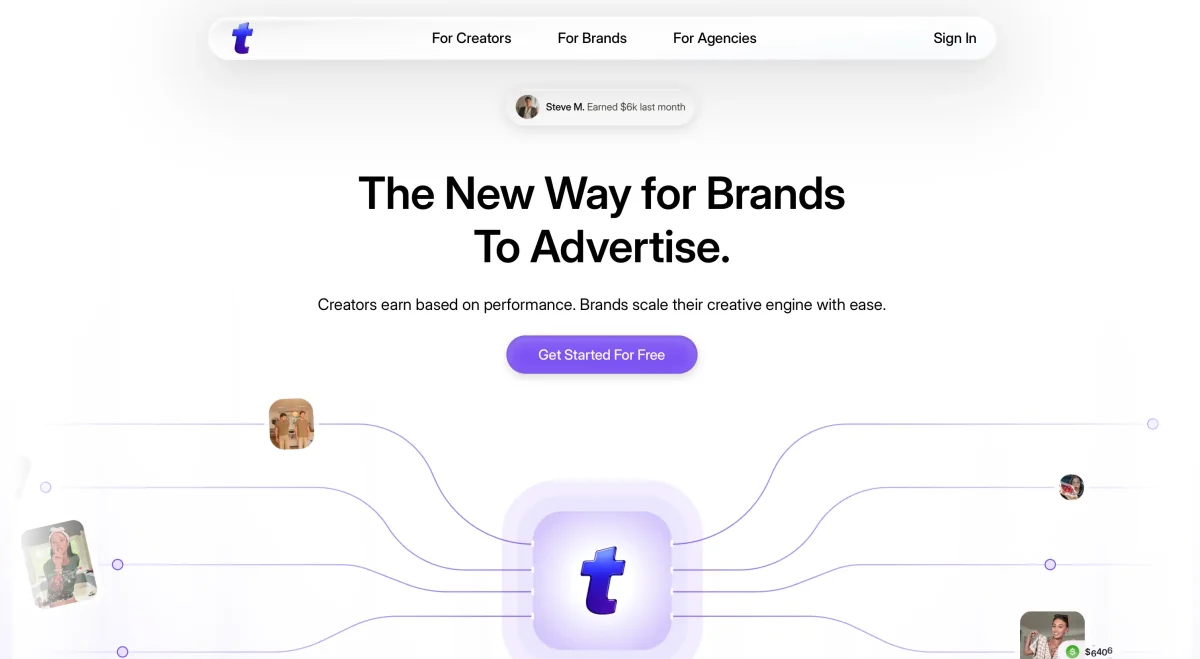
Trybe is an iPhone app that launched in 2026. It connects creators with brands, mostly online stores built on Shopify, that run creator videos as Meta ads on Facebook and Instagram. These are often whitelisted ads, meaning the brand runs paid ads that show your name and handle instead of the brand’s.
Each brand chooses how it pays. Options include:
- Sales commission. A percentage of GMV (gross merchandise value, meaning total sales) or a set amount per order.
- Ad performance commission. Pay tied to how your ad performs.
- Flat payments. Pay per submission, retainers (a steady monthly payment), and bonuses.
One showcase example on Trybe’s homepage shows a $640 payout built from $3,000 in sales plus a $250 retainer. Treat that as a top performer example, not a typical first month.
Side by Side Comparison
| Billo | JoinBrands | Trybe | |
|---|---|---|---|
| Pay model | Flat fee | Flat fee | Mostly performance |
| Typical starting pay | About $30 per video | From $60 per video | Commission per order or sale |
| Fee taken from you | None shown | 20% (15% on Pro) | Charged to brands |
| Income ceiling | Capped | Capped | No cap |
| Risk of $0 | Low | Low | Real |
| Device | iPhone or Android | iPhone or Android | iPhone only |
Real Numbers: Three Beginner Scenarios
Let’s say you make 4 videos a month. For Trybe, we will assume a brand pays $12 per order, which matches an earnings alert shown on Trybe’s site ($24 for 2 orders). Real rates vary by brand.
- All flat fee. Billo pays 4 x $30 = $120. JoinBrands pays 4 x $60 = $240, minus the 20% fee = $192. Predictable.
- Trybe, no winners. The brand tests your 4 videos and they drive 6 orders total. That is $72. If the brand never runs your videos at all, it is $0.
- Trybe, one winner. One video takes off and drives 100 orders, while the others drive 6. That is $1,200 plus $72 = $1,272. That is the upside, and it is not guaranteed.
Here is the break even math: at $12 per order, a video only needs 3 orders to beat Billo’s $30 and 4 orders to match JoinBrands’ $48 net. Easy, but only if the brand spends real money promoting your video.
So Which Model Actually Pays Beginners More?
In your first month, flat fee usually pays more, and more reliably. Early videos are practice, and brands test many creators before one wins. Over three to six months, performance pay can pay far more if your skills improve, because one strong video keeps earning while the ad runs.
Think of it this way: flat fee pays you for effort, and performance pay pays you for results.
Choose Flat Fee If You…
- Need predictable money for bills this month.
- Are still learning to film and edit.
- Want a portfolio of approved videos fast.
Choose Performance Pay If You…
- Can handle a slow month without stress.
- Enjoy studying hooks (the first 3 seconds that stop the scroll) and what sells.
- Genuinely like the brand’s product.
The Smart Move: A Hybrid Approach
You do not have to pick just one. Many creators start with flat fee work to build skills and cash flow, then add one or two performance brands. Some Trybe brands even mix a retainer with commission. It is the idea behind our side hustle ladder.
The Honest Downsides
- Flat fees cap your income. If your $30 video becomes the brand’s best ad, you still get $30.
- Revisions eat your time. Edit requests can push a payout back to pending.
- Performance pay depends on the brand. A weak product, small ad budget, or a brand that never runs your video can mean $0.
- Platform limits. Trybe is iPhone only, and JoinBrands’ 20% fee adds up.
Beginner tip: Do not drop reliable flat fee work for a performance deal until commission income has shown up consistently for at least two or three months.
How to Get Started This Week
- Film three sample videos. Use products you own. Natural light and clear audio beat fancy gear.
- Join one flat fee platform. Billo or JoinBrands gives you paid practice.
- Study hooks. Save ads that stop your scroll and note what happens in the first 3 seconds.
- Add Trybe once you have approved work. Pick brands whose products you would actually buy.
- Track everything. Log each video, pay type, earnings, and hours spent in a simple spreadsheet.
- Review monthly. Compare your real hourly rate and lean into what pays.
Like short videos? Also explore the Amazon Influencer program or offering social media management to local businesses.
A Quick Reality Check on Money
UGC creators are usually independent contractors, so taxes are not taken out of your pay. Set money aside from every payout. Free products can count as income too, so read whether free samples are taxable before your first gifted job. Rates change, so check current pay in each app.
The Fee Structure Is Adaptive
In the flat fee vs. performance pay for UGC debate, there is no single winner. Flat fee platforms like Billo and JoinBrands pay beginners more in the short term because the money is guaranteed. Performance platforms like Trybe can pay far more later, but only once your videos actually sell.
Start where you feel safe, build skills, and add performance deals as confidence grows. Your first $30 video is not the ceiling. It is the training ground.