
Month eight, and I want to be straight with you again. July was another step up.
Monthly Income: $343.46 Published Books: 10 (total now at 152 published)
Work is still demanding, life is still full, and I am still building this the slow and steady way. But the numbers kept moving in the right direction, and the story keeps getting easier to tell.
Total revenue for July came in at $343.46, up from June’s $332.93. That’s the eighth consecutive month of growth. Smaller jump than last month’s, but a jump all the same, and this one came with a wrinkle in the numbers that’s worth digging into.
Let me put that in perspective. I started this in December with zero books and zero dollars. A few months later I was at $151. By April I had reached $209. By May I was at $228.28. By June I had climbed to the low $330s. Now I’m at $343.46. Every month has been bigger than the last.
The Pricing Experiment: What the Split Actually Shows
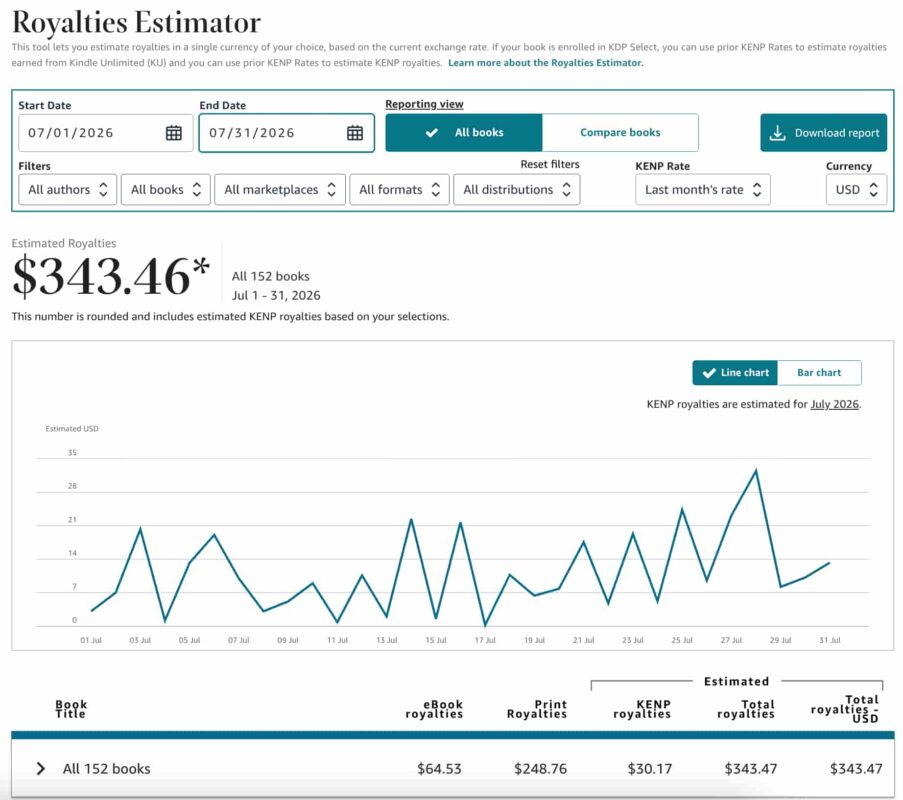
Last month I made the call to drop prices across the catalog; ebooks moved from a general $9.95 down to $5.95, and paperbacks moved from $16.95 down to $12.95. The theory was simple: more sales at a lower price should out-earn fewer sales at a higher one. July is the first full month that theory got to play out, and the KDP royalties breakdown told a more interesting story than I expected.
| Month | eBook royalties | Print royalties | KENP royalties | Total royalties |
|---|---|---|---|---|
| June | $96.80 | $206.54 | $29.59 | $332.93 |
| July | $64.53 | $248.76 | $30.17 | $343.46 |
eBook royalties actually fell month over month, even though the price drop was supposed to make ebooks the volume driver. What picked up the slack, and then some, was print. Paperback royalties jumped over $42, and KENP held essentially flat. Total revenue still grew, just not from the channel I expected.
My read on this: the lower ebook price alone didn’t generate enough extra volume to offset the lower per-unit royalty, at least not yet. But it may also mean the paperback price drop, combined with having a paperback option available for more titles, is doing more of the heavy lifting than the ebook price did. I don’t have enough data yet to call this conclusively, but it’s exactly the kind of signal I was hoping pricing experimentation would surface. I’ll keep watching the split over the next month or two before deciding whether to adjust ebook pricing again.
Slowing Down to Speed Up: Setting Up for Q4
I published 10 books this month, down from the 16-a-month pace I’d held for a while. That’s intentional, not a stumble. Most of July went into keyword and subject research, figuring out which niches and angles are likely to sell well heading into the holidays, rather than just pushing volume for its own sake.
That research is now shaping how I plan to spend Q4. The goal is to get solidly established across a handful of niches that perform well for gift-buying season, and to make sure every one of those titles has a paperback option, since paperbacks are the easier “buy this as a present” purchase for the right audience. I’d rather publish fewer books this month with the right angle than publish more books that miss the season entirely.
I’m still aiming for a 12–16 book monthly pace going forward; July’s 10 was a deliberate dip to do the groundwork, hopefully not a new normal.
This is also right on schedule with something I talked about last month: this kind of publishing business typically takes 8 to 12 months to find its footing, with the real goal being to peak in Q4 when buyer demand is highest. Month eight is exactly where the shift from “publish and evaluate” to “publish with intent” is supposed to happen, and that’s what July was.
The catalog is at 152 and climbing. The pricing experiment is still shaking out. And the next few months are about building toward the best quarter of the year, not just the biggest one.
The compounding is real. And it is still just getting started.